If you are still trying to rank on the first page of Google by targeting one isolated keyword per blog post, you are playing an outdated game. Gone are the days when a 500-word article stuffed with "best budget camera" could dominate the search results. Google’s algorithms, particularly after the Helpful Content Update and the rise of AI-driven search, have shifted toward a much more sophisticated metric: Topical Authority.
To win at SEO today, you don't just need to answer a question; you need to prove you own the entire subject. This is where content clusters come in. This strategy isn’t just a fancy way to organize your blog; it’s a structural overhaul of how you demonstrate expertise to search engines.
What Exactly is a Content Cluster?
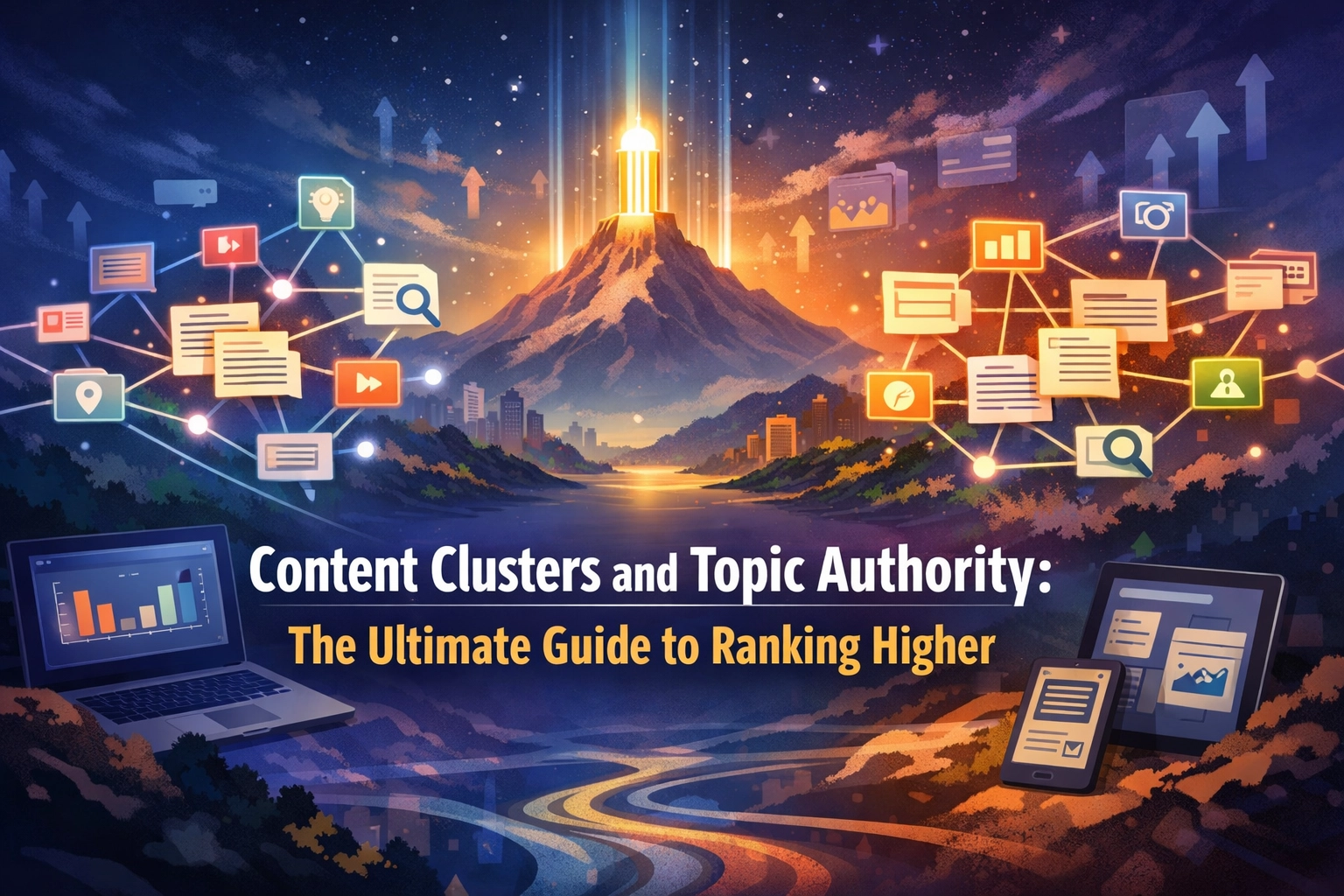
At its core, a content cluster is a group of interlinked pages built around a central "pillar" topic. Instead of having dozens of disjointed posts competing for attention, you create a neat, organized hierarchy that tells Google exactly how your content relates to itself.
The model consists of three main parts:
- The Pillar Page: A high-level, comprehensive guide on a broad topic (e.g., "The Ultimate Guide to Digital Marketing").
- Cluster Content: More specific, "deep-dive" articles that focus on subtopics related to the pillar (e.g., "A Beginner’s Guide to SEO" or "How to Run Facebook Ads").
- Internal Linking: The digital "glue" that connects the cluster pages to the pillar and to each other.

Why Topic Authority is the New Gold Standard
In the past, Google looked at individual pages. Today, it looks at the entire site’s footprint. Topical authority is a measure of how much "trust" you have built in a specific niche.
When you consistently publish high-quality content across a spectrum of related subtopics, search engines begin to view you as an expert. This results in a "halo effect." Once you have established authority in a niche: say, "Cloud Computing": any new article you write about cloud security or serverless architecture is likely to rank faster and higher because Google already trusts your site on that broader subject.
This shift was accelerated by Google’s Hummingbird update and further solidified by E-E-A-T (Experience, Expertise, Authoritativeness, and Trustworthiness). Google wants to send users to sources that show a deep understanding of the journey, not just a one-off answer.
How Content Clusters Transform Your SEO
The benefits of moving to a cluster model aren't just theoretical. They provide tangible technical and UX advantages that lead directly to higher rankings.
1. Improved Crawlability and Indexing
Search engine bots love structure. When your content is logically linked, bots can easily navigate from your pillar page to every supporting subtopic. This ensures that your entire "library" of content is discovered and indexed. If a page is "orphaned" (meaning nothing links to it), it’s much harder for Google to find and value it.
2. Semantic Relevance
Modern SEO is all about "entities" and "intent." Content clusters help Google understand the semantic relationship between different keywords. When you link a post about "Python for Data Science" to a pillar page about "Learning Python," you are giving Google a clear context. You aren't just talking about a snake; you are talking about a programming language in the context of data analysis.
3. Reduced Bounce Rates and Better UX
From a user perspective, clusters make sense. If someone lands on your site to learn about "Keyword Research," and you have a sidebar or internal links leading them to "Competitor Analysis" and "SEO Tools," they are much more likely to stay on your site. This increased dwell time signals to Google that your content is valuable and relevant to the user’s journey.

Step-by-Step: How to Build a Content Cluster Strategy
Building a cluster isn't just about writing more; it’s about writing smarter. Here is the workflow we use at blog and youtube to dominate our niche.
Step 1: Identify Your Core Pillar Topic
Your pillar topic should be broad enough to support at least 10 to 20 subtopics but specific enough to be relevant to your business goals.
- Bad Pillar: "Technology" (Too broad)
- Good Pillar: "Technical SEO for SaaS Companies" (Specific and broad enough for subtopics)
Step 2: Conduct Keyword Research for Subtopics
Once you have your pillar, look for the "spokes." Use tools like Semrush, Ahrefs, or even Google's "People Also Ask" section to find related questions and long-tail keywords. Each of these subtopics should be a standalone article that answers a specific query in detail.
Step 3: Audit Your Existing Content
You probably already have articles that fit into your new cluster. Don't let them sit in isolation. Map your existing blog posts to your new pillar. You might find that some posts need to be combined, while others need to be updated to link back to the central hub.
Step 4: The Internal Linking Secret
This is where most people fail. For a cluster to work, the linking must be intentional.
- Every Cluster Page must link back to the Pillar Page.
- The Pillar Page must link out to every Cluster Page.
- Cluster Pages should link to each other where it makes sense for the reader.
This creates a "web" of authority. If one cluster page starts getting a lot of backlinks and traffic, that "link juice" flows up to the pillar and spreads across the other cluster pages, lifting the entire group in search results.

The Technical Side: Schema and Data
To take your topical authority to the next level, you need to use Structured Data (Schema Markup). By using "About" and "Mentions" schema, you can explicitly tell search engines which entities your content is covering. This reduces the "guesswork" for the AI and helps you appear in rich snippets and the Knowledge Graph.
In the era of Generative Engine Optimization (GEO), having a clear, data-backed structure is vital. AI models like ChatGPT and Google's Gemini look for structured relationships between data points. A well-organized content cluster is essentially a roadmap for these AI models to understand your site's expertise.
Measuring Your Success
How do you know if your cluster strategy is working? Don't just look at total traffic. Look at:
- Keyword Footprint: Are you ranking for a wider variety of long-tail keywords?
- Topical Rankings: Is your pillar page climbing the ranks for its broad, high-volume keyword?
- Pages Per Session: Are users clicking through to your supporting articles?
- Backlink Distribution: Are people linking to various parts of your cluster, or just one page?
Common Pitfalls to Avoid
- Overlapping Topics: Don't write two articles that essentially answer the same question. This leads to keyword cannibalization, where your own pages compete against each other.
- Weak Pillar Pages: Your pillar page shouldn't just be a list of links. It needs to be a valuable resource on its own that provides a high-level overview of the entire subject.
- Forced Linking: Only link where it adds value. If a link feels forced or unnatural, it will hurt your user experience and potentially your SEO.

Future-Proofing Your Content
As we look toward 2026 and beyond, the competition for the top spot is only getting tougher. AI-generated content is flooding the web, making it easier than ever to produce "thin" content. The only way to stand out is to provide depth that an AI can't easily replicate without a clear structure.
Content clusters are not a "set it and forget it" tactic. They require ongoing maintenance. As new trends emerge in your niche, you should add new "spokes" to your existing pillars to maintain your freshness and authority.
Author Bio
Malibongwe Gcwabaza is the CEO of blog and youtube. With years of experience in the tech and digital media landscape, Malibongwe focuses on bridging the gap between complex technical SEO and simple, actionable business strategies. Under his leadership, the company has helped thousands of creators and businesses navigate the evolving world of AI, search algorithms, and content marketing. When he’s not dissecting the latest Google update, he’s exploring the intersection of technology and creativity to help brands build lasting online authority.
About the Author