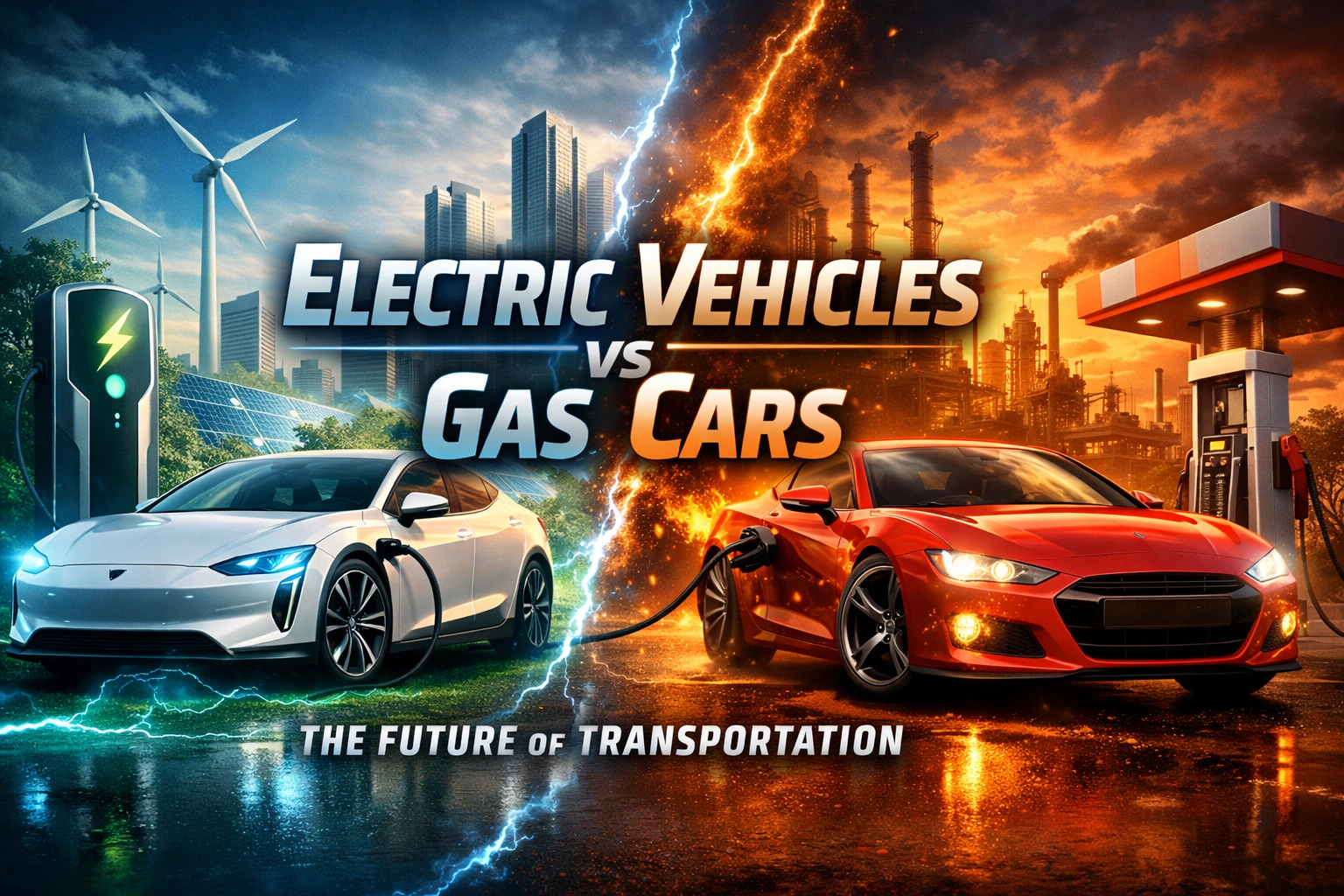
For decades, the sound of an internal combustion engine (ICE) was the heartbeat of our roads. But as we move through 2026, that rhythm is changing. The debate between Electric Vehicles (EVs) and gas-powered cars is no longer a niche conversation for tech enthusiasts or environmentalists; it is a mainstream financial and practical decision for every household.
If you are looking at a new car today, you aren't just choosing a brand; you are choosing a propulsion philosophy. Let’s break down the technical, financial, and lifestyle realities of both to see where the industry is heading.
The Cost Equation: Electricity vs. Petrol
In 2026, the financial argument for EVs has become almost impossible to ignore for the average commuter. Based on current energy prices, running an electric vehicle costs roughly 65% less per mile than a petrol-equivalent car.
To put numbers on it: charging at home typically costs about 7 pence per mile. In contrast, a modern, efficient petrol car still costs between 19 and 21 pence per mile. If you’re a driver doing 10,000 miles a year, you’re looking at an annual fuel saving of anywhere from £600 to £1,500.
However, the "upfront cost" remains the hurdle. While battery prices have dropped significantly due to advancements in solid-state tech and lithium-iron-phosphate (LFP) chemistry, EVs often still carry a higher sticker price. You have to look at the Total Cost of Ownership (TCO). When you factor in tax breaks: like the Benefit-in-Kind (BiK) rates which remain significantly lower for EVs: the gap closes rapidly within the first three years of ownership.

Mechanical Simplicity: Why Maintenance Differs
One of the biggest technical advantages of an EV is what isn't there. A traditional gas engine is a marvel of engineering, but it is incredibly complex, containing roughly 2,000 moving parts. You have pistons, valves, fuel injectors, a cooling system, an exhaust system, and a multi-speed transmission.
An electric drivetrain, by comparison, has about 20 moving parts.
What You Stop Paying For:
- Oil Changes: Non-existent in an EV.
- Spark Plugs and Timing Belts: Gone.
- Transmission Repairs: Most EVs use a single-speed reduction gear, meaning no complex gearboxes to fail.
- Brake Wear: Thanks to regenerative braking, the electric motor does most of the slowing down, which feeds energy back into the battery. This means your physical brake pads and discs can last two to three times longer than those on a gas car.
Research shows that EVs offer roughly 50% lower service costs over their lifetime. For a gas car, maintenance is a scheduled necessity to prevent catastrophic engine failure. For an EV, maintenance is largely about cabin filters, tire rotations, and checking the thermal management system for the battery.
Performance and the "Instant Torque" Factor
If you haven’t driven a modern EV, the first thing you’ll notice isn't the silence: it’s the neck-snapping acceleration.
Internal combustion engines have a "power band." They need to rev up to a certain RPM to reach their peak torque (pulling power). Electric motors, however, deliver 100% of their torque at zero RPM. The moment you touch the pedal, you have full power. This makes EVs exceptionally good for city driving, merging onto highways, and quick overtakes.
Gas cars still hold an edge in a specific type of performance: sustained high-speed power and towing. If you are towing a heavy trailer over long distances, a diesel or high-torque petrol engine remains more predictable. EVs can tow, but the aerodynamic drag of a trailer combined with the weight can slash an EV's range by 40-50%, making long trips a logistical challenge.
The Infrastructure Reality Check
We have to be honest: the gas station is still more convenient for the "unplanned" driver. You can pull into a station, fill up in five minutes, and have 400-500 miles of range ready to go.
EV charging in 2026 is a tale of two cities. If you have a driveway and a home charger, an EV is more convenient than a gas car. You "fill up" while you sleep. You never visit a gas station. You start every morning with a full "tank."
However, if you rely on public infrastructure, things get more complex. While the network is expanding rapidly, public rapid charging is significantly more expensive than home charging (often 55-79 pence per kWh).
- Level 2 Charging: Good for offices or malls (takes 4-8 hours).
- DC Fast Charging: Can get you from 10% to 80% in about 18-25 minutes on modern 800V architectures.
For the person who frequently drives 300+ miles in a single day without a home base, the gas car still provides a level of freedom that EVs are only just beginning to match.
Environmental Impact: Looking Beyond the Tailpipe
A common argument against EVs is that the "mining is just as bad as the drilling." While it's true that battery production is carbon-intensive due to the extraction of lithium, cobalt, and nickel, the lifetime CO2 footprint tells a different story.
By the time an EV reaches roughly 15,000 to 20,000 miles, it has "paid off" its carbon debt from manufacturing. From that point on, its footprint is significantly lower than a gas car, even when the electricity used to charge it comes from a mix of fossil fuels and renewables. In regions with high renewable energy penetration, an EV produces 50-70% less lifetime CO2.
Furthermore, gas cars produce tailpipe emissions (nitrogen oxides and particulates) directly into the streets where we breathe. EVs have zero tailpipe emissions, which is why many major cities are now implementing "Clean Air Zones" that charge gas cars to enter while letting EVs pass for free.

Efficiency: The Laws of Physics
This is where the gas car truly loses the battle. Internal combustion engines are remarkably inefficient. About 65-80% of the energy in a gallon of petrol is wasted as heat. Only a fraction actually turns the wheels.
Electric motors are roughly 85-90% efficient. They convert almost all the energy from the battery into motion. In a world where energy conservation is becoming a global priority, the sheer wastefulness of burning liquid fuel is becoming harder to justify from an engineering perspective.
Which One is Right for You in 2026?
The "Future of Transportation" isn't a one-size-fits-all answer. It depends entirely on your specific use case.
Buy an Electric Vehicle if:
- You can charge at home: This is the "killer app" for EVs.
- You commute daily: The fuel savings will pay for the car over time.
- You live in a city: You’ll save on congestion charges and enjoy a smoother, quieter ride.
- You want the latest tech: Most software-defined vehicle features are being built on EV platforms first.
Stick with a Gas/Hybrid Vehicle if:
- You do heavy towing: If you’re hauling a boat or a caravan across the country every weekend, the infrastructure isn't quite there yet.
- You live in an apartment with zero charging access: Relying solely on expensive public rapid chargers can negate the cost savings of an EV.
- You frequently drive in extreme remote areas: If your job takes you hundreds of miles away from the power grid, a jerry can of petrol is still the ultimate insurance policy.

Final Thoughts
The transition is happening faster than many predicted. As battery technology continues to evolve: moving toward solid-state batteries that offer 600+ miles of range and 10-minute charging: the remaining "pros" for gas cars will eventually vanish. For now, 2026 marks the tipping point where for the majority of people, the electric car is no longer just a "green" choice: it’s the smarter financial and mechanical choice.
About the Author: Malibongwe Gcwabaza
Malibongwe Gcwabaza is the CEO of blog and youtube, a leading digital hub dedicated to demystifying complex technology and making it accessible for everyone. With over a decade of experience in the tech and media landscape, Malibongwe focuses on how emerging trends: from AI to Green Tech: impact everyday lives. His mission is to provide simple, actionable insights that help creators and businesses navigate the rapidly changing digital world. When he's not steering the company's vision, he's exploring the latest gadgets and testing the limits of future-forward transportation.
About the Author