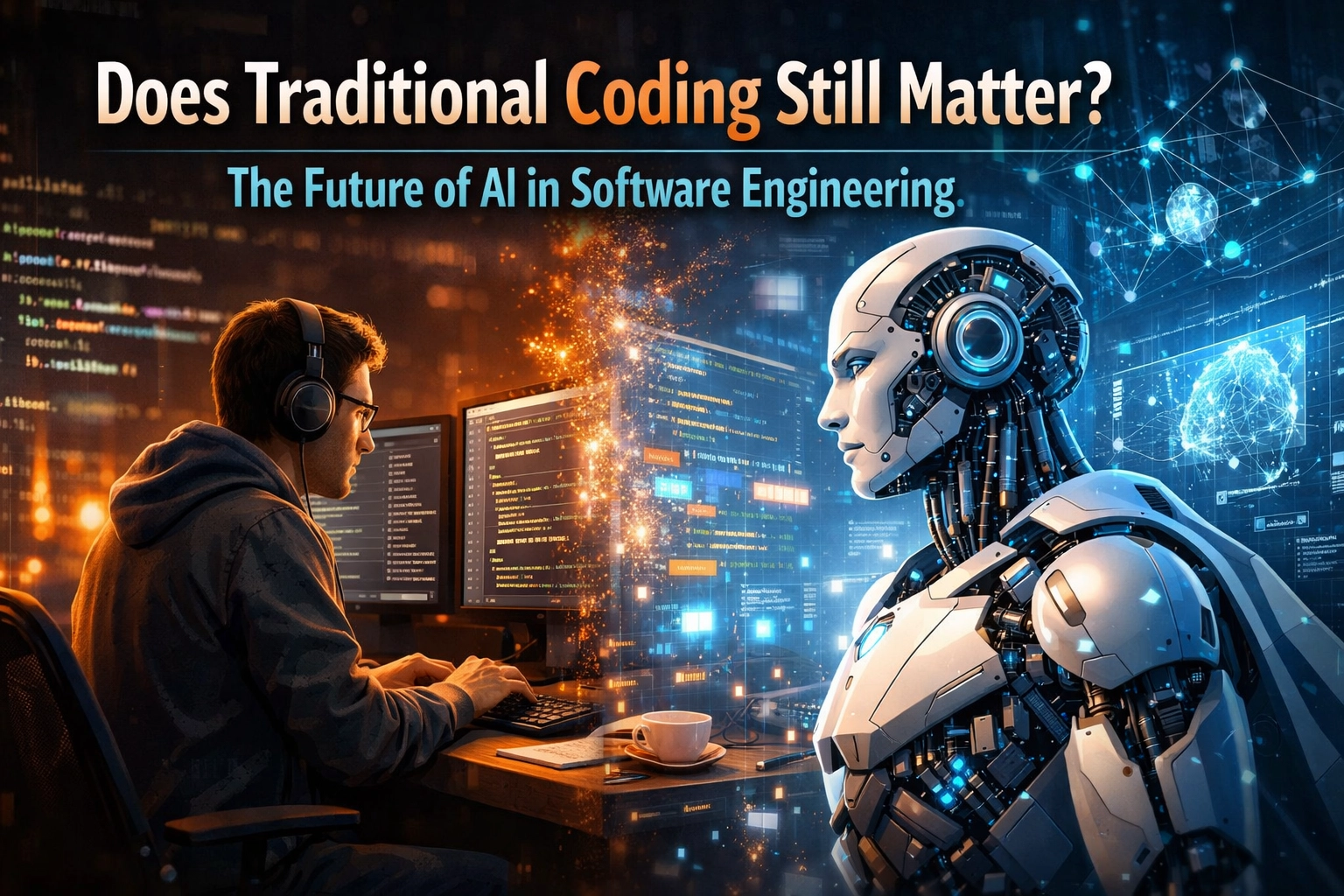
By 2026, the image of a software engineer hunched over a keyboard, meticulously typing out every semicolon and bracket, has become a bit of a relic. If you walk into any high-performing engineering team today, you’ll see screens filled with AI-generated suggestions, LLM-powered refactoring tools, and developers spending more time "talking" to their IDEs than manually declaring variables.
The shift is undeniable. With AI assistants now completing 30% to 40% of all code and some reports suggesting that 56% of engineers use AI for more than 70% of their daily tasks, the industry is facing an existential question: Does traditional coding still matter?
The short answer is yes: but the way we define "coding" has fundamentally changed. We are moving from an era of manual implementation to an era of technical orchestration.
The Death of the "Boilerplate" Era
For decades, a significant chunk of a developer’s job was "digital plumbing." We spent hours writing CRUD operations, setting up boilerplate for new microservices, and configuring environments. This wasn't necessarily creative work; it was mechanical.
AI has effectively killed this part of the job. Tools like GitHub Copilot, Cursor, and specialized LLMs can now generate scaffolding in seconds that would have taken a junior dev an entire afternoon. This has led to a documented 31.4% average productivity increase across the board.
However, speed is a double-edged sword. While AI handles the mechanical aspects: the syntax, the boilerplate, and the basic tests: it doesn't understand the "why" behind the code. It’s an expert at mimicking patterns, not at understanding the specific business logic or the long-term implications of a specific architectural choice.

The "Black Box" Risk: Why Foundations Are More Important Than Ever
One of the biggest traps developers fall into in 2026 is the "copy-paste-prompt" cycle. When you let an AI write 90% of your code by volume, you are essentially importing a "black box" into your codebase.
If you don't understand the underlying principles of memory management, concurrency, or data structures, you won't know when the AI is hallucinating a solution that works on the surface but fails under load. Traditional coding knowledge is the only thing that allows a developer to perform a meaningful code review.
Without deep technical foundations, you aren't an engineer; you're a prompt operator. And prompt operators are easily replaced. Engineers who understand how the underlying machine works are the ones who can audit the AI’s output for correctness, efficiency, and scale.
The Security Gap
Research has shown that approximately 30% of AI-generated code snippets contain security vulnerabilities. From SQL injection risks to outdated cryptographic libraries, AI often prioritizes "working code" over "secure code."
Traditional coding expertise is what allows you to spot a vulnerability in a block of code that the AI generated in three seconds. If you can't read the code manually, you can't secure it. This is why we are seeing the rise of the AI Code Auditor, a role that requires more traditional coding knowledge, not less.
From Coder to Architect: The Power of System Design
As the cost of writing an individual function drops to near zero, the value of the software development lifecycle shifts upward. The most valuable skill in 2026 isn't knowing how to write a Python decorator; it's knowing how that Python service fits into a global, distributed system.
AI is currently excellent at "micro" tasks but struggles with "macro" system design. It can write a function to process an image, but it struggles to design a scalable, cost-effective pipeline that handles ten million images an hour across multiple cloud regions while maintaining data integrity.

Traditional coding experience teaches you the "scars" of system failure. You learn why a certain database locking strategy failed in the past or why a specific API design led to a breaking change. AI doesn't have those scars. It only has the training data. The ability to make strategic architectural decisions: choosing between microservices and monoliths, or selecting the right edge computing strategy: remains a uniquely human, expert-level task.
The Emerging Developer Roles
The job market is already reflecting this shift. We are seeing a divide between two types of developers:
- The Hybrid Developer: Someone who uses AI to handle the 80% of mundane tasks but possesses the deep technical chops to dive into the assembly level or the kernel when things go wrong.
- The AI Specialist Developer: Engineers who don't just use AI tools, but build the agents and pipelines that automate the software lifecycle.
The "pure" manual coder who refuses to use AI is becoming inefficient. Conversely, the "pure" prompter who can’t explain how a hash map works is becoming a liability. The sweet spot is the developer who uses traditional coding knowledge as a filter for AI-driven production.

The Technical Debt Paradox
There is a hidden danger in the AI-coding era: Technical Debt Acceleration. Because it is now so easy to generate code, teams are shipping more features than ever. But more code means more surface area for bugs, more legacy systems to maintain, and more complexity to manage.
If a developer doesn't have a firm grasp on clean code principles (SOLID, DRY, etc.), they will use AI to generate "spaghetti code" at a much faster rate than a human ever could. Traditional coding discipline is the only thing that keeps an AI-augmented codebase from becoming an unmanageable mess within six months.
We are seeing a renewed focus on Refactoring Skills. In 2026, being able to take a massive, AI-generated codebase and simplify it is a superpower.
Does the Language Matter Anymore?
We used to argue about whether Java was better than C++ or if React was better than Vue. In the age of AI, the specific syntax of a language matters less. AI can translate between languages with high accuracy.
However, the paradigms still matter. Understanding functional programming vs. object-oriented programming is essential because it dictates how you prompt the AI and how you structure your logic. The "syntax" is being abstracted away, but the "logic" and the "philosophy" of the language remain the foundation of good software.

Final Thoughts: The Evolution, Not the End
Traditional coding isn't dying; it's evolving into a higher form of engineering. In the same way that compilers replaced manual assembly code, and high-level languages replaced punch cards, AI is simply the next layer of abstraction.
To stay relevant in this new landscape, you should:
- Master the Fundamentals: Don't skip the basics of algorithms, data structures, and system design. You need them to audit the AI.
- Focus on Security: Become an expert in identifying the vulnerabilities that AI frequently introduces.
- Learn Orchestration: Move your focus from writing lines of code to designing systems and managing AI agents.
- Embrace the 31%: Use the productivity gains from AI to focus on the hard problems: user experience, business logic, and innovative features: that AI can't solve on its own.
The keyboard isn't going away, but the way we use it certainly is. The future belongs to the engineers who can bridge the gap between human intuition and machine efficiency.
About the Author: Malibongwe Gcwabaza
Malibongwe Gcwabaza is the CEO of blog and youtube, a forward-thinking digital hub focused on the intersection of technology, software engineering, and AI. With over a decade of experience in the tech industry, Malibongwe specializes in helping businesses navigate the complexities of digital transformation. He believes that while tools change, the core principles of great engineering: clarity, security, and scalability: remain constant. When he's not leading his team, you can find him exploring the latest in SaaS trends and cloud architecture.
About the Author