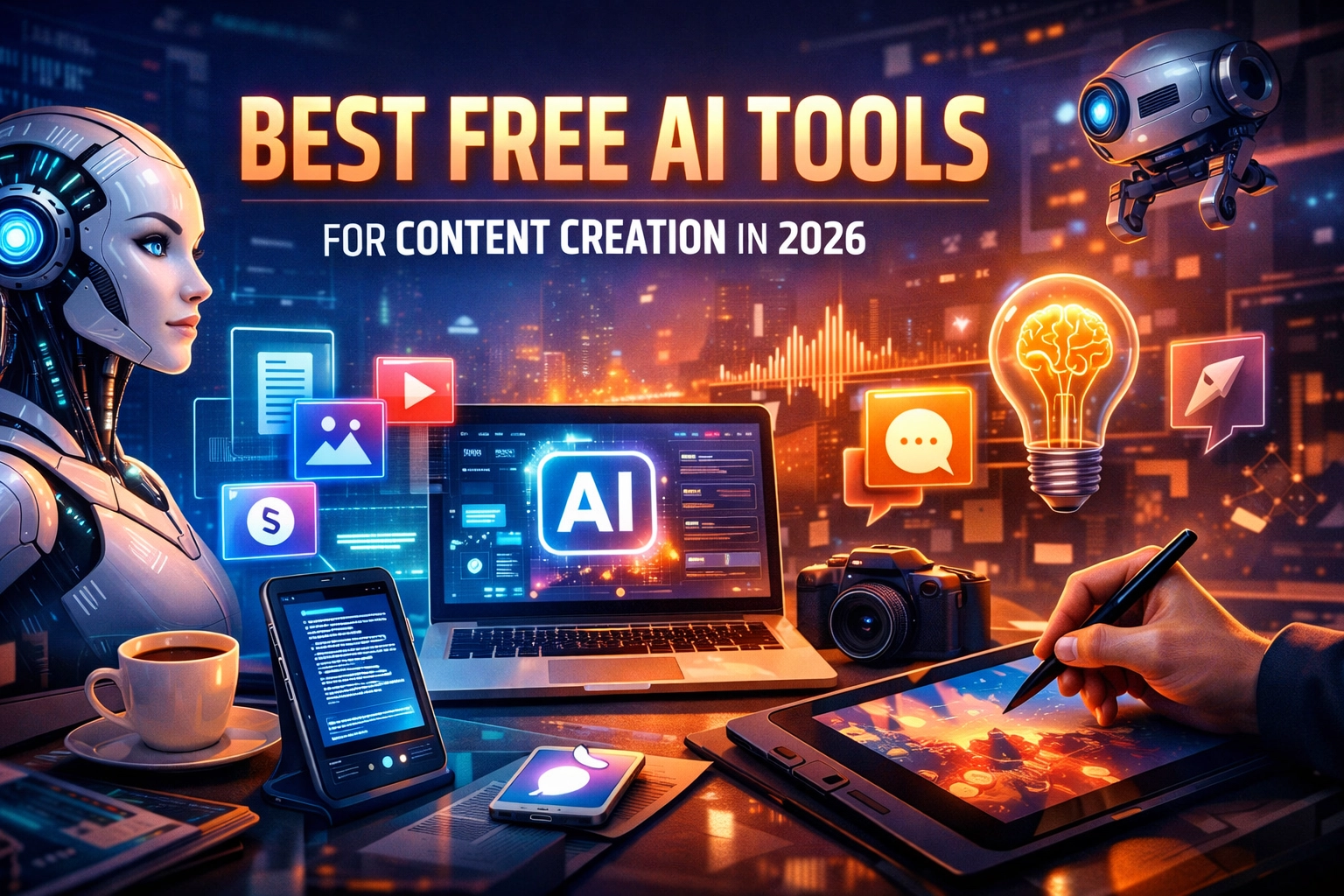
By 2026, the barrier to entry for content creation has effectively disappeared. We are no longer in the era of "AI as a novelty." Today, artificial intelligence is the fundamental infrastructure for every successful blog, YouTube channel, and social media brand. The challenge isn't finding a tool; it’s navigating a saturated market to find high-performance tools that don’t require a monthly subscription.
For creators looking to scale without heavy overhead, the "Freemium" landscape of 2026 offers capabilities that were locked behind $1,000/month enterprise paywalls just two years ago. From GPT-5.2 architectures to real-time consumer data synthesis, here is the definitive breakdown of the best free AI tools currently dominating the content landscape.
The Heavyweights of Text Generation: GPT-5.2 and Claude 4.5
In 2026, text generation has moved beyond simple predictive typing. The current leaders focus on "Reasoning-as-a-Service."
ChatGPT (GPT-5.2 Mini)
OpenAI’s free tier remains the industry standard for general-purpose ideation. As of March 2026, free users get access to the GPT-5.2 model with a cap of approximately 10 high-reasoning messages every five hours. Once the limit is hit, the system fails over to the "Mini" version, which is still faster and more accurate than the legendary GPT-4.
The primary advantage of GPT-5.2 in 2026 is its "Multimodal Memory." It remembers your brand voice across different sessions without needing a custom GPT setup. For bloggers, this means you can feed it a 2,000-word transcript from a YouTube video and ask for a structured SEO-optimized post in seconds.
Claude 4.5 Sonnet
Anthropic’s Claude remains the "Writer’s Choice." The free version of Claude 4.5 Sonnet offers a 200,000-token context window. To put that in perspective, you can upload three full-length eBooks, and Claude can find the thematic consistencies between them.
Claude’s edge in 2026 is its "Human-Centric Nuance." While other models can feel clinical, Claude 4.5 excels at long-form narrative. It avoids the repetitive sentence structures that often trigger AI detection filters, making it the best free tool for writing deep-dive essays and thought-leadership pieces. The free limit is tighter than ChatGPT: usually 10 to 20 messages per cycle: but the quality per message is arguably higher.

Short-Form Marketing and Copywriting
If you are managing a social media presence, you don't need a massive context window; you need speed and conversion-optimized hooks.
Copy.ai: The Workflow King
Copy.ai has pivoted from a simple text box to a "Workflow Automator." Their free plan provides 2,000 words per month. This is ideal for generating:
- Instagram captions with relevant 2026 trending hashtags.
- YouTube meta-descriptions that satisfy the latest algorithm updates.
- Email subject lines with high A/B test probability.
The "Brand Voice" feature in the free tier allows you to input your website URL, and the AI will scrape your existing content to ensure the copy it generates sounds exactly like you.
Rytr: The Budget Alternative
Rytr remains a favorite for creators who need high volume on a zero-dollar budget. With a 10,000-character monthly limit on the free plan, it’s best for "micro-content." It features a built-in plagiarism checker, which is crucial in 2026 as search engines have become increasingly aggressive in penalizing unoriginal content.
Research-Backed Content and Fact-Checking
The biggest risk in 2026 content creation is "Hallucination-Induced Misinformation." If your blog provides incorrect data, your E-E-A-T (Experience, Expertise, Authoritativeness, and Trustworthiness) score will plummet. These tools solve that.
Perplexity: The Search Engine Killer
Perplexity has replaced traditional Google searching for most creators. Instead of a list of links, Perplexity provides a cited narrative. In 2026, its "Pages" feature allows you to turn a research query into a full-blown report with images and citations in one click.
For technical writers, Perplexity is indispensable because it indexes real-time data. If a software update was released ten minutes ago, Perplexity can find the documentation, whereas traditional LLMs might rely on training data that is months old.
GWI Spark: The Data Scientist in Your Pocket
Most creators guess what their audience wants. GWI Spark allows you to use actual consumer data. Its free tier provides insights from a global panel of nearly a million consumers. You can ask, "What are the primary concerns of Gen Z tech buyers in South Africa in 2026?" and get data-backed insights to guide your content strategy.

Visual Content: Image and Design Integration
Visuals are no longer optional. With the rise of visual search, every blog post needs high-quality, original imagery to rank.
Gemini and the Google Ecosystem
Google’s Gemini is the most integrated tool for creators using the Workspace suite. The free version offers 100 AI credits monthly for "Imagen 3" (Google’s latest image generation engine).
The standout feature here is "Direct-to-Doc." You can generate an image and a draft directly inside a Google Doc. In 2026, Gemini’s ability to understand spatial consistency means you can generate a series of images featuring the same character or product without them looking like different versions in every frame.
Canva: The All-in-One Editor
Canva’s "Magic Studio" has evolved significantly. While many features are behind the Pro wall, the free version in 2026 allows for:
- Magic Edit: Swap out objects in a photo using text prompts.
- Text-to-Graphic: Generate simple icons and elements that match your brand's color palette.
- AI Layouts: Feed the tool a block of text, and it will suggest five different design layouts for a social media post.

The Rise of Free AI Video Tools
Video is the highest-leverage content format in 2026. While high-end rendering still costs money, several tools offer incredible free capabilities.
CapCut (Desktop & Mobile)
Owned by ByteDance, CapCut’s AI features are 2026’s best-kept secret for YouTubers. The free version includes:
- Auto-Captions: 99% accuracy in over 50 languages.
- AI Video Upscaling: Take 1080p footage and upscale it to 4K using neural networks.
- Script-to-Video: Input a script, and CapCut will pull relevant B-roll from its free library and assemble a rough cut for you.
HeyGen (Free Trial Tier)
While HeyGen is primarily a paid tool, their free daily credits allow for the creation of "AI Avatars." This is perfect for creators who want to produce "faceless" YouTube channels or provide quick video updates without setting up a camera and lighting.

Strategic Implementation: The Multi-Tool Workflow
The most successful creators in 2026 don't use just one tool; they build a "stack." Here is the most efficient free workflow for a 1,500-word blog post:
- Research (Perplexity): Spend 5 minutes gathering the latest data and verified citations.
- Ideation (GWI Spark): Check consumer trends to see which "angle" of your topic is currently trending.
- Drafting (Claude 4.5): Use the research from Perplexity to generate a deep-dive draft.
- Refining (ChatGPT 5.2): Feed the draft into ChatGPT to create a punchy introduction and a high-conversion call to action.
- Visuals (Gemini/Canva): Generate three supporting images and a hero banner.
- Promotion (Copy.ai): Generate 5 Twitter (X) posts and 2 LinkedIn updates based on the final blog content.
Technical Considerations for 2026
When using these free tools, keep an eye on Inference Latency. In 2026, "Mini" models are optimized for speed, while "Sonnet" or "Pro" models are optimized for logic. If you are doing a simple rewrite, use the faster, smaller models to save your high-reasoning credits for complex tasks.
Additionally, always check the Privacy Toggles. Most free AI tools in 2026 use your input data to train their future models by default. If you are working on proprietary information or a "top secret" startup launch, ensure you have opted out of data training in the settings menu.
About the Author: Malibongwe Gcwabaza
Malibongwe Gcwabaza is the CEO of "blog and youtube," a leading digital strategy firm specializing in the intersection of AI and the creator economy. With over a decade of experience in software architecture and content systems, Malibongwe focuses on making complex technology accessible to independent creators and startups. His mission is to empower the next generation of digital entrepreneurs through simple, actionable tech insights.
About the Author