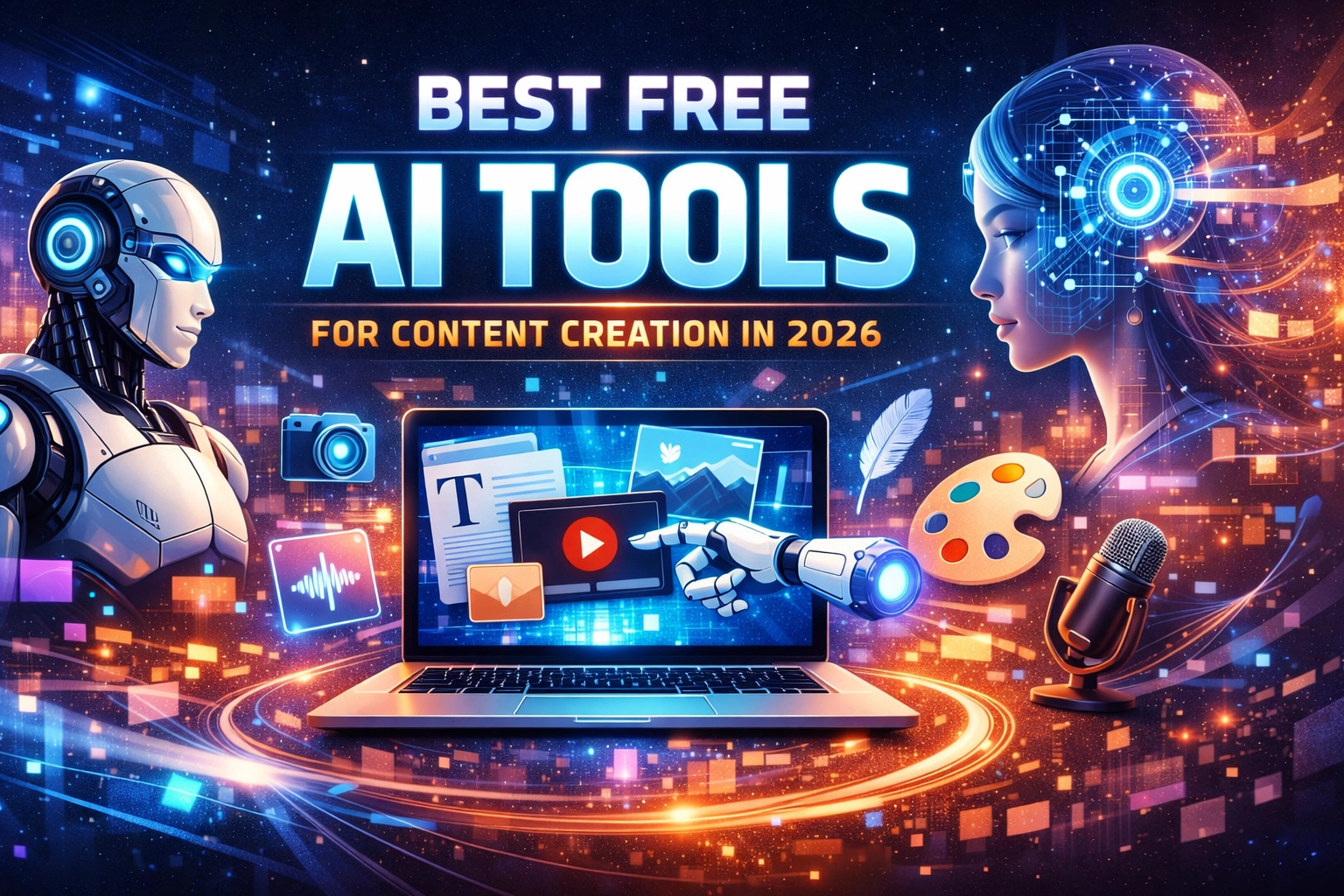
The landscape of content creation has shifted dramatically by 2026. We are no longer in the era of simple chatbots; we are in the era of specialized agents. For creators, this means the barrier to entry has never been lower, but the bar for quality has never been higher. To stand out, you need to leverage tools that don't just generate text, but provide depth, research accuracy, and visual flair.
The good news? You don't need a massive budget to access world-class technology. The "freemium" model has matured, offering robust tiers that allow independent creators and small businesses to compete with major agencies. Here is a deep dive into the best free AI tools for content creation in 2026.
The Powerhouses: General-Purpose Writing and Ideation
When it comes to the core of your content: the writing: two giants dominate the space. In 2026, the choice between them usually comes down to your specific workflow and the length of the content you’re producing.
1. ChatGPT (GPT-5.2)
OpenAI’s flagship continues to be the most versatile tool in a creator's arsenal. The free tier now offers access to GPT-5.2, albeit with usage limits.
- How it works: You get approximately 10 high-reasoning messages every 5 hours. Once you hit that limit, the system rolls you over to a "mini" version that is faster but slightly less nuanced.
- Best for: Content ideation, structural outlines, and complex logic tasks. If you are stuck on how to transition between two difficult topics in an article, GPT-5.2’s reasoning capabilities are unmatched.
- Pro Tip: Use the "Custom Instructions" feature to define your brand voice once. This prevents you from having to repeat your style requirements in every single prompt.
2. Claude 4.5 Sonnet
Anthropic’s Claude has become the darling of long-form writers. Many creators prefer it over ChatGPT because its prose tends to feel more "human" and less formulaic.
- The Technical Edge: The free tier of Claude 4.5 Sonnet provides a massive 200,000-token context window. This means you can upload an entire ebook or a series of long transcripts, and the AI can reference any part of it without "forgetting" the beginning.
- Limits: You typically get 10 to 25 messages every 5 hours, depending on demand.
- Best for: Ghostwriting, long-form blog posts, and maintaining a consistent narrative voice over thousands of words.

Research-Backed Content and Fact-Checking
One of the biggest risks in AI content creation is "hallucination": when an AI confidently states something false. In 2026, specialized research tools have solved much of this problem.
3. Perplexity AI
Perplexity isn't a traditional writing tool; it’s a "discovery engine." For creators who need to write about technical topics or current events, it is indispensable.
- Real-Time Data: Unlike standard LLMs that have a "knowledge cutoff," Perplexity crawls the live web. When you ask it a question, it provides a summary with clickable citations.
- Why it saves time: Instead of spending hours on Google, you can ask Perplexity to "Find the latest statistics on EV adoption in South Africa for 2025" and get a cited report in seconds.
- Free Tier: Offers unlimited basic searches and a limited number of "Pro" searches (which use more advanced models like Claude 3.5 Opus or GPT-4o) per day.
4. GWI Spark
For creators focused on marketing and consumer behavior, GWI Spark is a game-changer. It provides access to data-driven insights from nearly a million real consumers across 50+ global markets.
- The Value: Instead of guessing what your audience wants, you can use GWI to validate your narrative. If you’re writing about tech trends, GWI can tell you exactly which age groups are most concerned about data privacy.
- Free Access: Their entry-level tier allows for basic demographic queries that can add "meat" and authority to your blog posts or YouTube scripts.
Visuals and Multimedia Design
In 2026, a blog post without high-quality visuals is essentially invisible. AI has moved beyond basic filters to full-scale asset generation.
5. Canva (Magic Studio)
Canva has successfully integrated AI into every corner of its platform. Their "Magic Studio" is the gold standard for creators who aren't professional designers.
- Key Features: The "Magic Media" tool allows you to generate images and short video clips from text prompts directly inside your design.
- Content Refinement: The "Magic Switch" feature can take a blog post and automatically turn it into a series of Instagram slides or a LinkedIn carousel.
- Free Tier: While some premium elements are locked, the free version provides enough AI credits monthly to maintain a consistent social media presence.

6. Adobe Express
Adobe Express is the "lite" version of Creative Cloud, and it’s packed with Firefly-powered AI features.
- Generative Fill: This is its superpower. You can upload a photo, highlight an area, and tell the AI to "add a laptop to the desk" or "change the background to a sunset."
- Free Tier: Adobe offers a generous free plan that includes many of these generative features, making it a strong competitor to Canva for those who want a more "professional" edit.
Short-Form Copy and Social Media
If you are managing multiple social channels, you don't have time to craft every tweet or caption from scratch. Specialized marketing AIs are better at this than general-purpose bots.
7. Copy.ai
Copy.ai focuses specifically on the psychology of marketing. It is built for conversion.
- Workflows: The 2026 version of Copy.ai allows you to build "workflows." For example, you can set up a system where you input a link to your latest YouTube video, and the AI automatically generates a blog summary, three tweets, and a newsletter blurb.
- Free Tier: You get 2,000 words per month on the free plan, which is perfect for micro-content.
8. Rytr
Rytr is the go-to for creators on a budget who need something fast and lightweight. It’s particularly good for product descriptions and catchy email subject lines.
- Character Allowance: Instead of a word limit, Rytr often operates on a character-based free tier (around 10,000 characters per month).
- Use Case: Use Rytr for the "boring" stuff: meta descriptions for SEO, YouTube video tags, and Pinterest descriptions.

Specialized SEO and Ecosystem Integration
9. Google Gemini
Gemini is Google’s answer to ChatGPT, and its biggest selling point is integration.
- The Google Workspace Edge: If you use Google Docs or Gmail, Gemini lives right inside the interface. You can highlight a paragraph in Docs and ask Gemini to "make this more professional" or "expand this into three bullet points."
- Free Tier: The free version provides a high-speed model with 100 monthly AI credits for creative tasks, which is plenty for drafting emails and basic article sections.
10. Machined
Machined is a specialized tool for SEO content clusters. While it’s a "freemium" tool, its approach is unique.
- Content Clusters: Instead of writing one article, Machined helps you write a "cluster" of 10 related articles to dominate a specific topic in search results.
- The "Bring Your Own Key" Model: In 2026, many tools like Machined offer a free interface but require you to plug in your own OpenAI or Anthropic API key. This is often much cheaper than a flat monthly subscription because you only pay for exactly what you use.
Strategic Stacking: How to Use These Tools Together
The most efficient creators in 2026 don't just use one tool; they "stack" them. Here is a sample workflow:
- Research: Use Perplexity to find current facts and data points.
- Strategy: Use GWI Spark to identify which angle will resonate most with your target audience.
- Drafting: Feed your research notes into Claude 4.5 Sonnet to generate a high-quality long-form draft.
- Visuals: Use Canva to create the header image and social media graphics.
- Distribution: Use Copy.ai to turn the blog post into a newsletter and social media snippets.
By using the free tiers of these specific tools, you can produce content that looks like it came from a team of ten, while only spending a few hours of your own time.
About the Author: Malibongwe Gcwabaza
Malibongwe Gcwabaza is the CEO of "blog and youtube," a leading digital consultancy dedicated to making complex technology accessible to everyone. With over a decade of experience in content strategy and digital marketing, Malibongwe focuses on how AI can be leveraged to empower creators and small businesses in the modern economy. He believes that technology should be a bridge, not a barrier, and spends his time testing the latest tools to find the most efficient workflows for his clients. Under his leadership, "blog and youtube" has grown into a go-to resource for simple, actionable tech advice.
About the Author