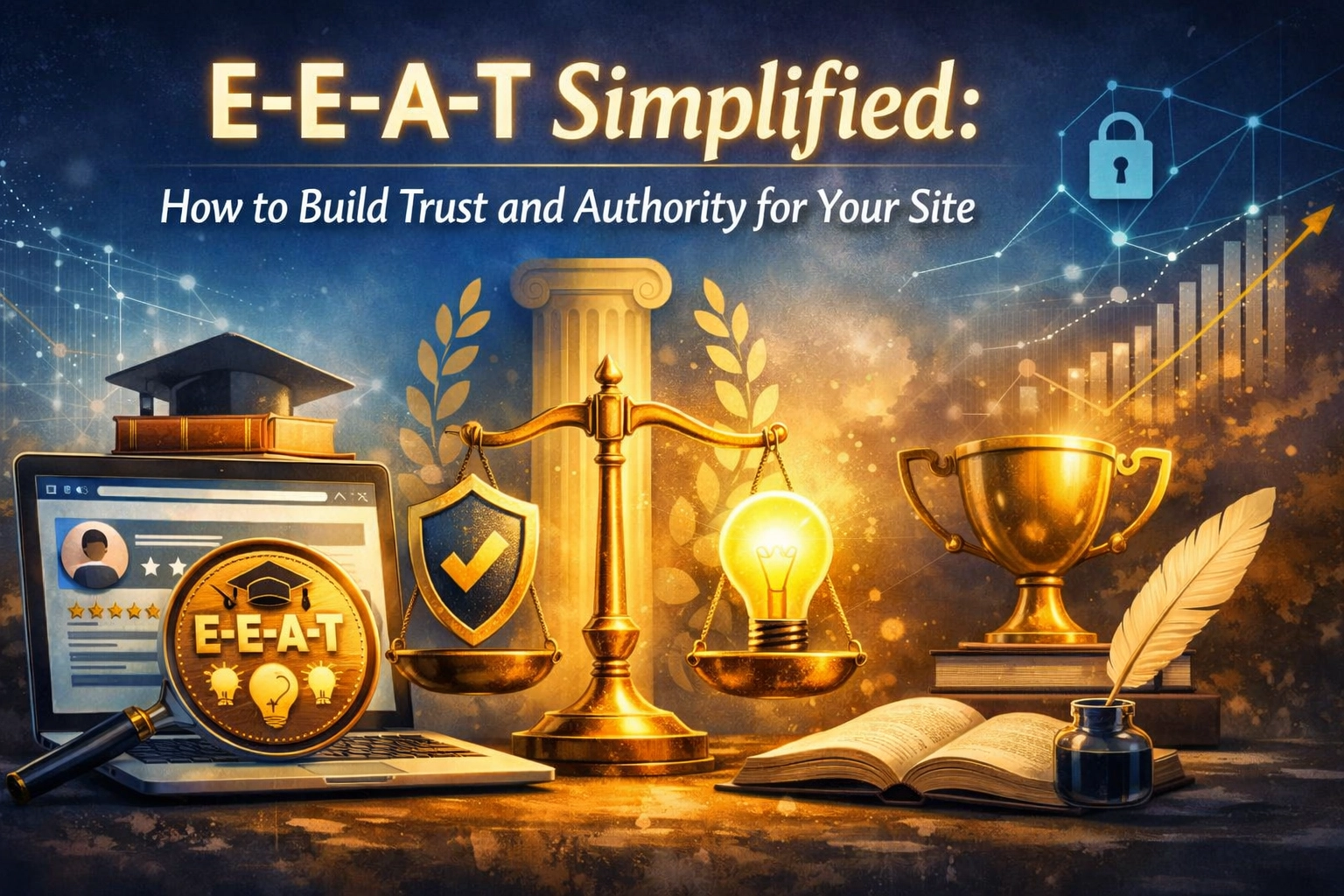
Search engine optimization in 2026 isn't just about keywords and backlinks anymore. If you’ve been tracking Google’s algorithm shifts over the last few years, you’ve likely seen a four-letter acronym pop up everywhere: E-E-A-T. It stands for Experience, Expertise, Authoritativeness, and Trustworthiness.
While it’s not a direct "ranking factor" in the sense that a meta tag is, E-E-A-T is the framework Google’s Search Quality Raters use to determine if a piece of content is actually helpful to a human being. In an era where AI can churn out thousands of generic articles in seconds, E-E-A-T is the filter that separates the noise from the signal.
The Evolution: Why the Extra "E"?
For a long time, we just had E-A-T. In December 2022, Google added a second "E" for Experience. This was a massive shift. It signaled that Google doesn't just want to see that you have a degree in a subject (Expertise); they want to see that you’ve actually done the thing you’re writing about.
Think about it this way: if you’re looking for a review of the latest iPhone, would you rather read a spec sheet written by a tech journalist who hasn't seen the phone, or a hands-on review from someone who dropped it, charged it, and used the camera in low light for a week? That’s the power of Experience.

Breaking Down the Pillars
To build a site that stands the test of time (and algorithm updates), you need to understand how these four pillars interact.
1. Experience (The "Do-er" Factor)
Experience is about first-hand, lived participation. It’s the "I was there" factor.
- How to show it: Use personal anecdotes. Instead of saying "The best way to learn Python is through practice," say "When I first started learning Python, I spent three days stuck on a syntax error that taught me the importance of indentation."
- Visual Proof: Use original photos and videos. Stock photos scream "generic." Original photos of you using a product or a screenshot of a dashboard you’re managing prove you have skin in the game.
2. Expertise (The Knowledge Factor)
Expertise refers to the formal or informal mastery of a subject. While Experience is about doing, Expertise is about knowing. For "Your Money Your Life" (YMYL) topics: like health, finance, or legal advice: formal credentials are non-negotiable.
- How to show it: Link to your certifications, degrees, or professional history. If you’re writing about medical tech, having a background in bio-engineering provides the Expertise that a generalist writer lacks.
3. Authoritativeness (The Reputation Factor)
Authoritativeness is your reputation in the industry. It’s how much other people look to you as a leader. When other high-authority sites link to you or mention your name, your "Authority" grows.
- How to show it: Focus on Topical Authority. Don't write one post about AI and then one post about gardening. Write 50 posts about AI. Cover every niche, every sub-topic, and every frequently asked question. When you own a topic, Google starts to see you as the go-to resource.
4. Trustworthiness (The Foundation)
Trust is the most important part of the E-E-A-T puzzle. If a reader doesn’t trust you, the other three pillars don’t matter. Trust is built through transparency and accuracy.
- How to show it: Ensure your site is secure (HTTPS). Provide clear contact information. Have a robust "About Us" page. Most importantly, cite your sources. If you quote a statistic, link to the original study.

Actionable Strategies to Boost Your E-E-A-T
Building authority doesn't happen overnight, but you can start making technical and editorial changes today that will signal to Google (and your readers) that you are a trusted source.
Optimize Your Author Bios
Every post should have a clear, professional author bio. Don't just list a name. Include:
- Professional titles or degrees.
- A brief summary of years of experience in the field.
- Links to social media profiles (LinkedIn is especially important for professional credibility).
- A link to a full "Author Page" that lists all articles written by that person.
Implement Schema Markup
This is a more technical step but it’s vital for "telling" search engines who you are. Use Person Schema and Organization Schema. This structured data helps Google connect the dots between your website and your professional identity across the web. It clarifies that "Malibongwe Gcwabaza" on this blog is the same "Malibongwe Gcwabaza" mentioned in industry publications.
Audit Your Existing Content
Go back to your old posts. Are they thin? Are they outdated?
- Update Statistics: A post from 2022 with 2020 data looks untrustworthy.
- Add Personal Insight: Can you add a "Lesson Learned" section to an old tutorial?
- Fact-Check: Ensure all outgoing links still work and lead to reputable sites.
Build a "Content Cluster"
To build Authoritativeness, stop thinking in terms of single articles and start thinking in "Clusters."
- Pillar Page: A long-form, comprehensive guide on a broad topic (e.g., "The Ultimate Guide to Tech SEO").
- Cluster Content: Smaller, specific articles that dive deep into sub-topics (e.g., "How to Fix 404 Errors," "A Guide to Robot.txt").
- Internal Linking: Link all your cluster articles back to the pillar page and vice versa. This tells Google that you have covered the topic from every possible angle.

The Role of User Experience (UX) in Trust
You could have a PhD in a subject, but if your website is full of pop-up ads, takes 10 seconds to load, and has broken images, no one will trust your information.
- Site Speed: Use tools like Google PageSpeed Insights to ensure your site is fast.
- Mobile-First: Most of your users (and Google's crawler) are on mobile. If your site is hard to navigate on a phone, your Trustworthiness score will plummet.
- Clean Design: A simple, professional layout suggests a professional operation. Avoid cluttered sidebars and aggressive "Buy Now" buttons that distract from the educational content.
E-E-A-T and AI Content
With the rise of Large Language Models, many site owners are tempted to automate everything. However, AI lacks Experience. It can summarize facts (Expertise), but it can't tell you what it felt like to implement a strategy.
To future-proof your site, use AI as a research assistant, not a ghostwriter. Take the raw data AI provides and layer it with your unique perspective, your mistakes, and your specific case studies. This "Human Overlay" is what will keep you ranking when generic AI sites get filtered out.
Summary Checklist for E-E-A-T
If you want to ensure your site is aligned with Google’s quality standards, use this quick checklist:
- Does the article include personal experience or original research?
- Is the author’s expertise clearly stated in a bio?
- Are all factual claims backed up by links to reputable sources?
- Is the website’s "About Us" and "Contact" information easy to find?
- Is the content part of a larger, well-organized topic cluster?
- Is the site technically secure and fast?
E-E-A-T is about moving away from "gaming the system" and moving toward providing genuine value. By focusing on these four pillars, you aren't just optimizing for an algorithm: you're building a brand that people (and search engines) will return to for years to come.
About the Author
Malibongwe Gcwabaza is the CEO of blog and youtube. With over a decade of experience in the digital content landscape, Malibongwe has navigated the shift from keyword-stuffing tactics to the modern, E-E-A-T-focused era of SEO. He is passionate about helping creators build sustainable, authority-driven platforms that prioritize human value over bot-friendly fluff. When he’s not analyzing search trends, he’s experimenting with new tech and sharing insights on the company’s YouTube channel.
About the Author