Building a Software-as-a-Service (SaaS) product in 2026 is no longer just about getting code to run on a server. It’s about engineering a recurring value machine. With the global SaaS market projected to soar past $300 billion, the competition is fierce, and the barrier to entry: while lower thanks to AI: demands a higher standard of execution.
Whether you are a solo developer or a CEO scaling a technical team, the roadmap from an initial spark to a profitable launch requires a blend of ruthless prioritization and architectural foresight. This guide breaks down the technical and strategic layers of modern SaaS development.
1. Market Validation: Solving the "Hair on Fire" Problem
The biggest risk in SaaS isn't technical failure; it's building something nobody wants to pay for. Before you write a single line of React or Python, you must validate the problem.
We look for "Hair on Fire" problems: issues so painful that users are already trying to hack together a solution using Excel, manual emails, or outdated legacy tools.
The Framework for Validation:
- The Mom Test: Don't ask friends if your idea is good. Ask them about their current workflow and where they spend the most money or time.
- Competitor Gap Analysis: Use platforms like G2 or Capterra to find 1-star reviews of existing SaaS giants. What are they missing? Is it speed? Is it a specific integration?
- Landing Page Smoke Test: Build a simple page describing the solution and see if people are willing to leave an email address or a "pre-order" deposit.
2. Planning the Architecture: The Foundation of Scalability
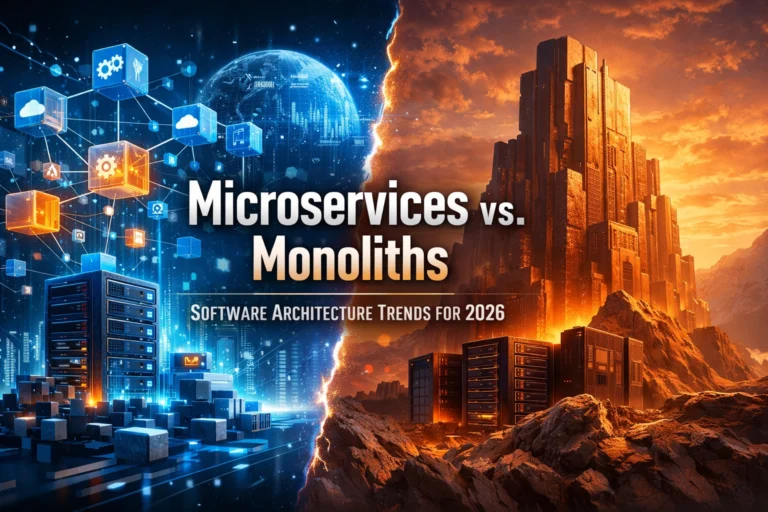
A common mistake is over-engineering on day one. However, under-engineering the core architecture leads to "rewrite hell" six months later. For SaaS development, your architecture must handle Multitenancy: the ability for a single instance of the software to serve multiple customers (tenants) while keeping their data strictly isolated.
The Modular Monolith vs. Microservices
In the early stages, lean toward a Modular Monolith. It allows your team to move fast without the overhead of managing 20 different repositories and complex networking between microservices. You can always decouple services later as you scale.

The 2026 Tech Stack Recommendation:
- Frontend: Next.js or React. These frameworks offer Server-Side Rendering (SSR) which is crucial for SEO: a major growth lever for SaaS.
- Backend: Node.js (TypeScript) or Python (FastAPI). Both have massive libraries for AI integration and third-party APIs.
- Database: PostgreSQL. It’s the gold standard for SaaS due to its reliability and support for both relational data and JSONB for flexible metadata.
- Infrastructure: AWS or Vercel. Use Infrastructure-as-Code (Terraform or Pulumi) so your environment is repeatable and documented.
3. Designing for Retention (UX/UI)
SaaS success is measured by churn. If your UI is confusing, users will leave before they reach the "Aha!" moment. Modern SaaS design focuses on Time to Value (TTV). How quickly can a user sign up and see the core benefit?
Key UX Principles:
- Frictionless Onboarding: Use social logins (Google/GitHub) and avoid asking for 20 profile details upfront.
- Command Palettes: (CMD+K) interfaces have become a standard for "pro" SaaS tools, allowing users to navigate features without touching a mouse.
- Empty States: Don't show a blank screen. Show templates, guides, or "dummy data" to illustrate what the platform looks like when fully utilized.
4. Building the Minimum Viable Product (MVP)
The goal of an MVP is to test the "core loop" of your application. If you’re building a project management tool, the core loop is: Create Task -> Assign Task -> Complete Task. Everything else (dark mode, profile pictures, advanced reporting) is secondary.
The "SaaS Core" Checklist:
Every SaaS needs these four "boring" features before it can be considered a product:
- Authentication & RBAC: Role-Based Access Control. Can an "Admin" see things a "Viewer" cannot?
- Subscription Management: Integration with Stripe or Chargebee. Do not try to build your own billing engine.
- Tenancy Isolation: Ensure Tenant A can never, under any circumstance, see Tenant B's data at the database query level.
- Audit Logs: Crucial for B2B SaaS. Companies need to know who changed what and when.

5. Security and Compliance: The Non-Negotiables
In the world of SaaS development, security is a feature. If you are targeting enterprise clients, you will eventually need SOC2 or ISO 27001 compliance. Starting with a security-first mindset saves you from expensive audits later.
- Data Encryption: Encrypt sensitive data at rest (AES-256) and in transit (TLS 1.3).
- API Security: Implement rate limiting to prevent DDoS attacks and use JWT (JSON Web Tokens) for secure session management.
- Privacy by Design: With GDPR and CCPA, you must give users the ability to export or delete their data easily.
6. The DevOps Pipeline: Shipping with Confidence
You can't scale a SaaS if every deployment feels like a heart transplant. You need a CI/CD (Continuous Integration / Continuous Deployment) pipeline.
The Ideal Flow:
- Pull Request: Developer submits code.
- Automated Testing: Unit tests and Integration tests run automatically via GitHub Actions or GitLab CI.
- Preview Environment: A temporary URL is generated to test the feature in a live-like environment.
- Production Merge: Code is deployed to production with zero downtime using "Blue-Green" or "Canary" deployments.

7. The Launch: Moving from Dev to Growth
Launch day is not a single event; it's a series of ripples.
- Soft Launch: Invite your "waitlist" users first. Fix the bugs they find before the world sees it.
- Product Hunt / Hacker News: These are great for initial traffic but remember they are "tourist" traffic. Focus on converting them into long-term users.
- Analytics: Integrate tools like PostHog or Mixpanel. You need to see where users are dropping off in your funnel. If 90% of people sign up but only 5% create their first project, your onboarding is broken.
8. Post-Launch: The Iteration Loop
Once the product is live, your job shifts from "Building" to "Listening." SaaS development is an infinite loop of feedback.
- Collect Feedback: Use in-app widgets or Slack communities.
- Prioritize: Don't build every feature requested. Use the RICE framework (Reach, Impact, Confidence, Effort) to decide what’s next.
- Scale Infrastructure: As your database grows, you’ll need to implement caching (Redis) and database indexing to keep the app snappy.

Conclusion: It’s a Marathon, Not a Sprint
Building a SaaS is a grueling but rewarding journey. By focusing on a "modular" technical foundation, validating your market early, and prioritizing user experience, you position yourself to build a product that doesn't just launch, but lasts.
The most successful SaaS products aren't the ones with the most features; they are the ones that solve a specific problem so well that the user can't imagine going back to the old way of doing things.
About the Author: Malibongwe Gcwabaza
CEO of blog and youtube
Malibongwe Gcwabaza is the CEO of "blog and youtube," a platform dedicated to demystifying complex technology for modern entrepreneurs. With over a decade of experience in software strategy and digital content, Malibongwe focuses on bridging the gap between high-level engineering and business growth. When he isn't advising on SaaS architecture, he's exploring the latest trends in AI and cloud computing.
About the Author